
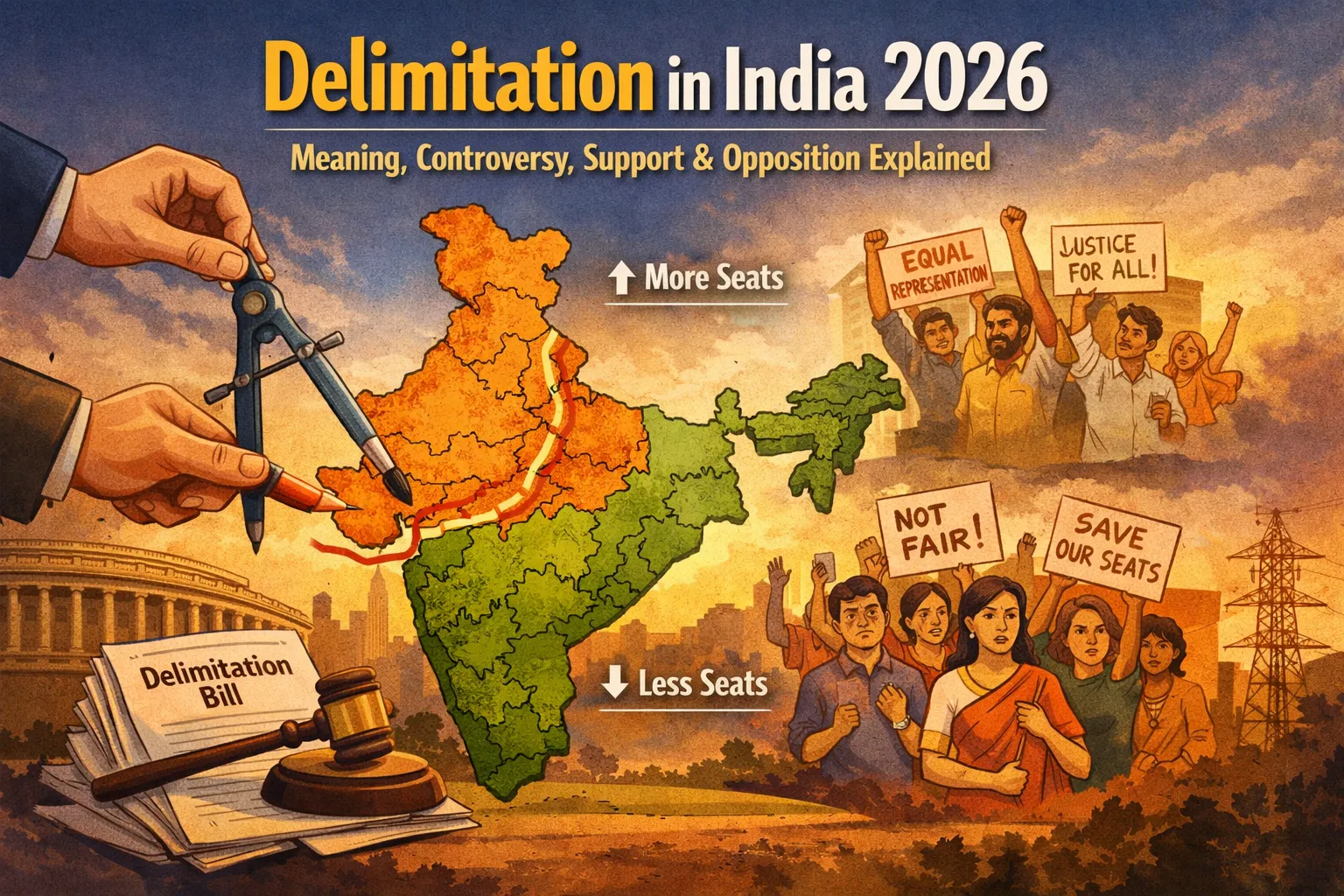
What is Delimitation in India 2026
Delimitation in India 2026 has become one of the most debated political topics in the country. Delimitation in India 2026 refers to the process of redrawing electoral constituencies based on population changes, and it has raised major concerns about fairness, representation, and political balance between states.
The main objective is to ensure equal representation so that each elected representative speaks for a similar number of people. This follows the democratic principle of equal value for every vote.
In India, delimitation is carried out by the Delimitation Commission of India, which is appointed by the central government and works independently.
This article explains delimitation in India 2026 in a simple and unbiased way, including why it failed, who supported it, and what it means for states like Tamil Nadu.
Why Delimitation is Important
Delimitation plays a key role in maintaining electoral fairness and balance in democracy.
Equal Representation
It ensures that constituencies with higher populations do not have unfair advantages compared to smaller ones.
Population Adjustment
It updates seat distribution according to demographic changes over time.
Strengthening Democracy
It helps maintain the principle that every citizen’s vote carries equal weight.
Background of Delimitation in India
Delimitation in India has been carried out multiple times after independence.
Major Delimitation Years
- 1952
- 1963
- 1973
- 2002
However, delimitation has been frozen since 1976 to encourage population control. This freeze is expected to end after 2026, which triggered the recent debate.
Why Delimitation in India 2026 Became Controversial
The 2026 delimitation discussion created strong political and regional tensions across India.
Population-Based Seat Redistribution
The proposal was to increase Lok Sabha seats based on population data.
This could lead to:
- Northern states gaining more seats
- Southern states losing relative influence
Impact of Delimitation in India 2026 on Southern States
States like Tamil Nadu, Kerala, and Karnataka have controlled population growth more effectively.
These states fear they may lose political power despite better development performance.
Fear of Political Power Shift
There is concern that representation in Parliament may shift heavily toward northern states, changing the balance of power in national decision-making.
Why the Delimitation Bill Failed in 2026
The delimitation-related proposal faced a major setback in Parliament.
Lack of Required Majority
Constitutional amendments require a two-thirds majority. The bill failed to secure enough support in the Lok Sabha.
Linking with Women’s Reservation
The government linked delimitation with women’s reservation implementation.
Opposition parties argued that both issues should be handled separately, which created resistance.
Strong Opposition Unity
Several opposition parties came together and opposed the bill, calling it politically motivated and unfair to certain regions.
Resistance from Southern States
Political leaders from southern India strongly opposed the proposal, highlighting the risk of reduced representation.
Who Supported Delimitation
Bharatiya Janata Party (BJP)
The Bharatiya Janata Party supported delimitation based on population.
Their main arguments:
- Equal representation based on population
- Correcting outdated constituency sizes
- Strengthening democratic fairness
Supporting Viewpoint
Supporters believe that democracy should reflect current population realities, not outdated data.
Who Opposed Delimitation
Indian National Congress
The Indian National Congress opposed the bill, especially its linkage with women’s reservation.
Dravida Munnetra Kazhagam (DMK)
The Dravida Munnetra Kazhagam strongly opposed delimitation.
Key concern:
States that successfully controlled population growth may lose political influence.
All India Trinamool Congress
The All India Trinamool Congress raised concerns about federal imbalance and political bias.
Southern States Collective View
States like Tamil Nadu, Kerala, Karnataka, and Telangana expressed concern over losing representation in Parliament.
Key Debate Around Delimitation
Arguments in Favour
- Ensures equal population representation
- Updates outdated electoral boundaries
- Strengthens democratic fairness
Arguments Against
- Penalizes states with better population control
- Creates regional imbalance
- May shift political power unfairly
What Happens After 2026
Delimitation in India 2026 is expected after the next census cycle.
However, due to strong opposition:
- The process may be delayed
- A revised formula may be introduced
- A balance between population and development may be considered
Possible Solutions for Fair Delimitation
Experts suggest alternative approaches:
Balanced Formula
Combine population with development indicators
Seat Protection
Ensure minimum representation for all states
Gradual Implementation
Introduce changes step by step instead of sudden shifts
Verdict on Delimitation in India
Delimitation is necessary for a growing democracy like India. However, implementing it purely based on population may create imbalance between regions.
A fair approach should consider both population and development to ensure equal and just representation for all states.
Conclusion
The delimitation debate in 2026 reflects a larger question about fairness in Indian democracy.
While updating constituency boundaries is essential, the method of implementation will decide whether it strengthens or disrupts the balance of power in India.
FAQ
What is delimitation in simple terms
Delimitation is the process of redrawing electoral boundaries based on population.
Why is delimitation important
It ensures equal representation and fair voting power.
Why did delimitation fail in 2026
It failed due to lack of majority, opposition resistance, and controversy over population-based seat allocation.
Which states oppose delimitation
Southern states like Tamil Nadu, Kerala, and Karnataka oppose it due to fear of losing representation.
Will this effect Tamil Nadu poll in 2026?
Delimitation in India 2026 follows constitutional provisions, and you can understand the official process from the Delimitation Commission of India.
According to policy analysis, delimitation in India 2026 is expected to significantly change seat distribution based on population growth.
Recent political developments show that delimitation in India 2026 has triggered strong opposition due to concerns about regional imbalance.
Last updated on: April 18, 2026